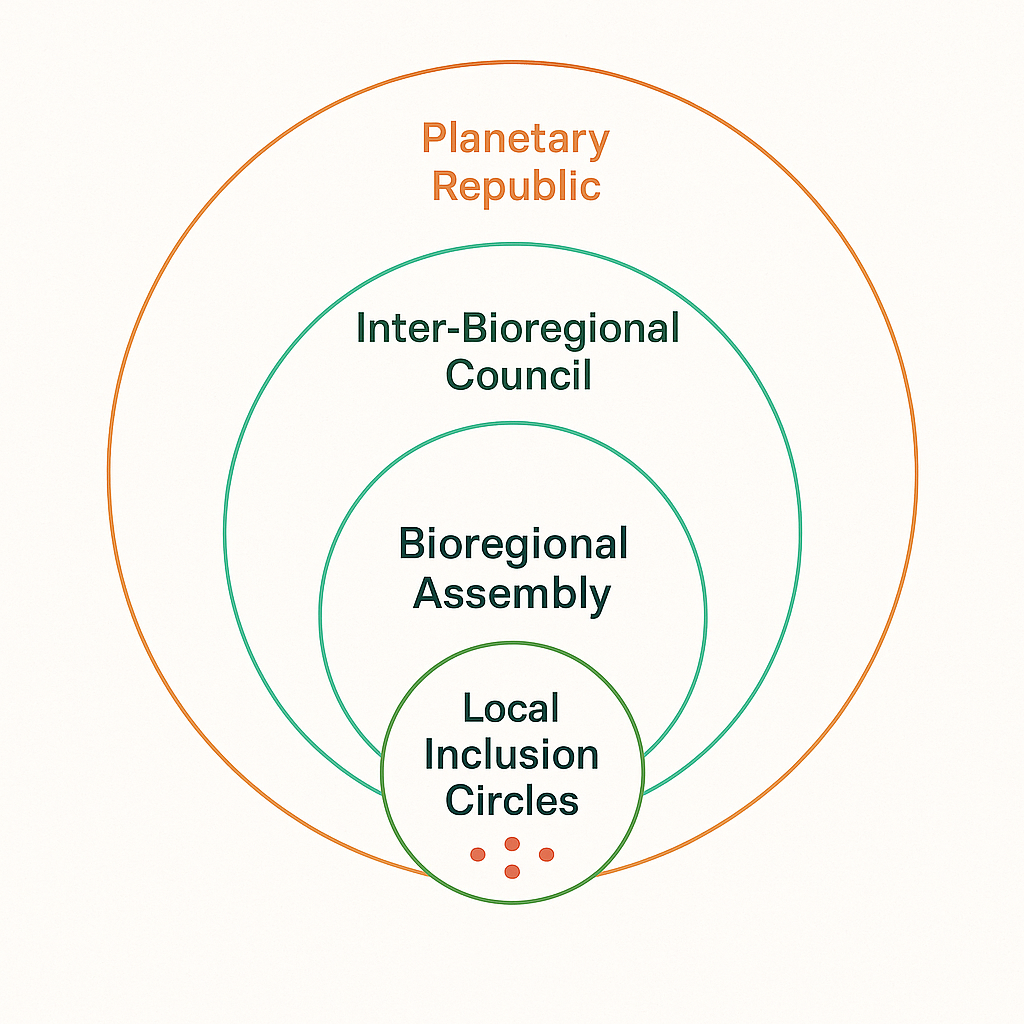
1. PROBS Starts Small (Movement-Building Phase)
Legal Container: In the U.S., a 501(c)(3) (education/charitable) or a 501(c)(4) (advocacy/political) could be a smart first step. This gives us legitimacy, a bank account, and the ability to accept donations and apply for grants.
Why not a new “government” yet? Because trying to declare sovereignty too early makes us vulnerable to being dismissed as fringe or even treated as subversive. We can start as a movement and a commons project.
Activities:
Education: workshops, reading groups, online explainer content.
Local pilots: start building Inclusion Circles in our towns or bioregions.
Commons projects: community gardens, watershed monitoring, soil restoration — real, tangible contributions.
Record everything: build the PROBS Field Manual as we go.
2. Federation Phase (Networks of Circles)
Once multiple communities adopt Inclusion Circles: we federate.
Inter-bioregional councils form with representatives carrying mandates.
This creates the first planetary scaffolding.
Tech backbone emerges (open ledgers, shared platforms, mapping tools).
Funding can scale from donations → grants → cooperative finance models.
3. Parallel Governance Phase
At this point, PROBS is no longer “just” a nonprofit. It becomes a parallel institution:
Still within the law (like how the Haudenosaunee Confederacy exists alongside the U.S. and Canada).
Still collaborative with existing states — but visibly offering governance functions states can’t:
Protecting commons,
Ensuring transparency,
Coordinating across borders,
Representing displaced peoples or bioregions.
Nations may start signing treaties with PROBS (just as they do with NGOs or tribal nations now). That’s a major milestone.
4. Horizon Phase: Beyond Nation-State Primacy
We don’t “dissolve” nation-states outright. They fade in centrality as PROBS builds legitimacy.
Think EU vs. national parliaments — the EU didn’t abolish France or Germany; it created a higher layer that gradually took over some roles.
Eventually, as crises intensify (climate migration, pandemics, planetary defense needs), states will lean on PROBS. That’s when the balance of legitimacy shifts.
Long term dissolution achieves our goals without the need for violent revolution.
5. What Can a Community Do Right Now?
Here’s a concrete playbook:
Form a Circle: Host an open assembly — invite neighbors, faith groups, schools, activists. Frame it as: “Let’s imagine how our town could connect to planetary survival.”
Find the Name of your Bioregion: Map your watershed, soils, ecosystems. Anchor your identity in place, not State-recognized boundaries.
Pilot a Commons Project: e.g. a community solar co-op, a watershed clean-up, or a community land trust. Make it practical, not just visionary.
Create Transparency Tools: Publish a simple open ledger of funds/donations. Practice accountability.
Link Outward: Connect with other towns or communities experimenting with similar ideas (even globally). This creates the first PROBS network-of-networks.
Tell the Story: Document what you’re doing — online, in print, with art. PROBS grows when stories spread. #PlanetaryRepublic
Attend Assemblies: Attend our assemblies and keep us posted on what you’re up to.